Oriental Aesthetics Office Space Design: Who is the Best Beijing Office Space Designer in China
Oriental Aesthetics Office Space Design: Who is the Best Beijing Office Space Designer in China
In the current era of increasingly homogenized commercial environment design, how to integrate Eastern aesthetics with contemporary office needs has become an important direction for exploring cultural brand spaces. The "Who is the Most Chinese" Beijing office space, designed by CUN inch DESIGN Cui Shu and Li Hui, is located in the Baiziwan Park and covers an area of 1000 square meters. It is divided into a 600 square meter office area and a 400 square meter cultural space called "Who Garden", presenting a spatial practice of deep integration between "human and nature", "soft decoration design" and "commercial environment design".
Dual expression of Eastern aesthetics: garden interest and spiritual blank space
Who Garden "does not adopt the white tone of traditional art galleries, but instead restores the most primitive texture of the building by peeling off the wall plaster. In a 6-meter high space, gray columns stand tall, creating a spiritual atmosphere of openness and space. More than 60 years ago, red bricks transformed from a functionalist facade to a stage backdrop, carrying multiple activity scenes such as culture, art, and design. Sunshine, drizzle, gentle breeze, and drifting snow intertwine in the space, endowing the site with an inner spirit of "international wabi sabi style", which is not only a reflection of Eastern artistic conception, but also the most restrained acceptance of natural elements.
The office area creates a spatial pattern of "winding paths leading to secluded places and changing scenery" in Chinese gardens through the interweaving of blocks and the organization of flow lines. The office area is enclosed by a half height low wall, which not only ensures psychological privacy, but also creates a sense of hierarchy in the visual sense. Large area mirrors and glass partitions complement each other, creating an infinite and expansive experience within a limited area.
Human and Nature: From Functionality to Spirituality
The connection between "human and nature" is particularly emphasized in the design. Whether it is the preservation of the original texture of the building in 'Whose Garden', the introduction of seasonal changes, or the aesthetic of shade created by lighting, materials, and spatial rhythm in the office area, all reflect people's delicate attention to environmental perception. As Hai Feng, the organizer of "Who is the Most Chinese?" said, "The ultimate goal of design is not architecture or space, but the state of people in space, the spiritual pleasure in an unconscious state
The integration of soft decoration design and commercial environment design
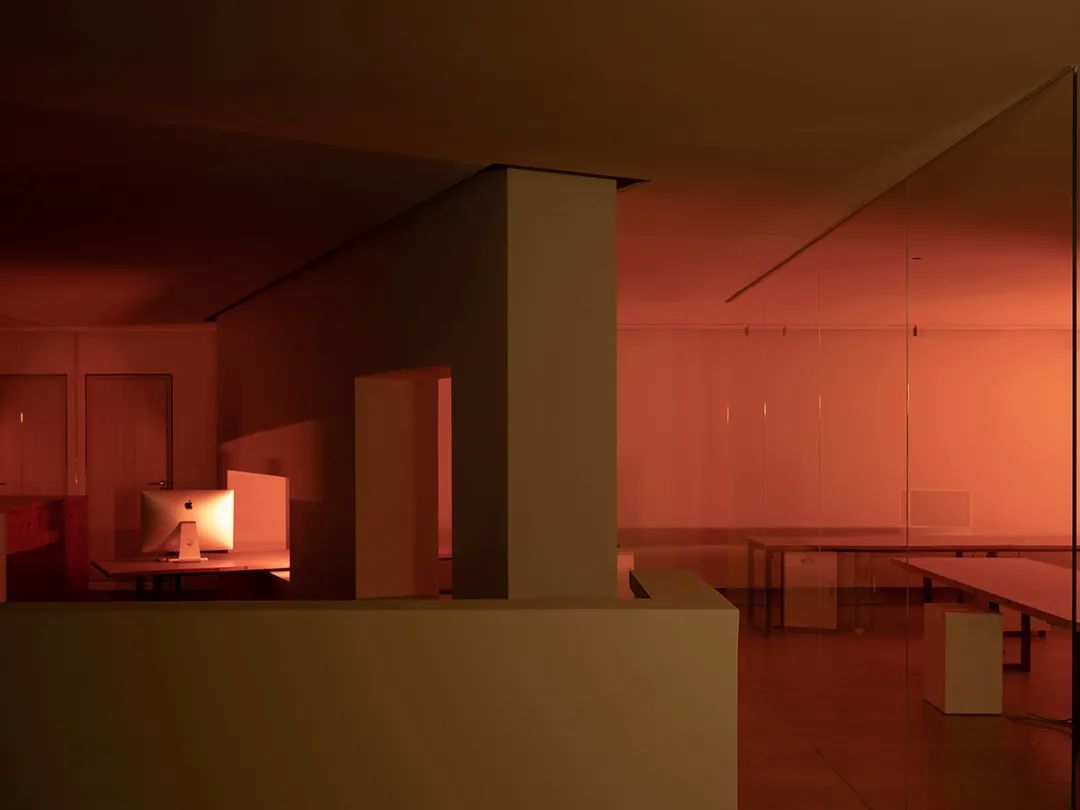
In terms of soft decoration design, the space does not pile up concrete Eastern symbols, but conveys the Eastern state through materials, light and shadow, and scale. In 'Whose Garden', elements such as furniture, utensils, flower arrangement, and tea art are naturally presented in the scene, becoming a carrier of cultural and commercial integration. The "peeping" and "niche" on the entrance wall of the office area break the sense of seriousness between one collection and one release, reflecting the designer's exquisite control over details. Office lighting meets functional requirements during the day and switches to the orange color scheme of the Forbidden City at night, creating a unique Eastern atmosphere and enhancing the cultural added value of the commercial environment.
Cultural Strategies in Business Environment Design
As a cultural media brand, 'Who is the Most Chinese' achieves the unity of content and field through this space. The two spaces are like two sides of one body, serving as both a place for the team's daily creative work and a platform for cultural exchange with the outside world. After its completion, 'Who Garden' quickly became a venue for cultural, artistic, and design activities, reflecting the key role of commercial environment design in brand value extension.
This space does not see any tangible Eastern objects, but presents an intangible Eastern state in the overall atmosphere. It provides a reference paradigm for cultural brands' office spaces in commercial environment design - with Eastern aesthetics as the core, human and nature as the clues, and through soft decoration design and spatial strategy, a contemporary workplace that combines spirituality and functionality is constructed.
Main project design: Cui Shu, Li Hui
Address: Beijing, China
Area: 1000 square meters
Keyword tags: Media, China, Beijing, Oriental aesthetics, Aestheticism, Red bricks, Gardens, Commercial environment design, Minimalism



 Chinese
 English
 French
 Spanish
 Russian
 Arabic