Monash University Caulfield Campus: Campus Environment Design with Caf é and Landscape Terrace
Monash University Caulfield Campus: Campus Environment Design with Caf é and Landscape Terrace
The basement renovation project of Building H at Monash University's Caulfield Campus was designed by the Jackson Clements Burrows Architects team to create a diverse space that integrates campus and commercial environment design. The project covers an area of 1100 square meters and was completed in 2018. The photography was taken by Peter Clarke.
This renovation covers multiple functional areas: a lecture hall equipped with advanced facilities, two flexibly separable conference rooms, a flexible and diverse space that can be converted from a daytime caf é mode to an evening event mode, and a campus terrace connected to the north end of Queen's Road for scenic views.
The core of design is to establish a visual connection between the interior and the outside world. The original basement space was dimly lit and enclosed. After renovation, natural lighting and good ventilation were introduced through a 3.5-meter-high ceiling, large floor to ceiling glass windows, and an open outdoor terrace, greatly enhancing the transparency of the space. The entrance of the coffee area is surrounded by a green belt, and the decorative material is selected in neutral light tones, creating a harmonious and unified atmosphere that naturally blends with the overall campus environment.
In the connecting corridor area, the design team has set up two seaters with small screen partitions, suitable for students to relax, communicate or study, reflecting the attention to humanized details in the design of university campus environment.
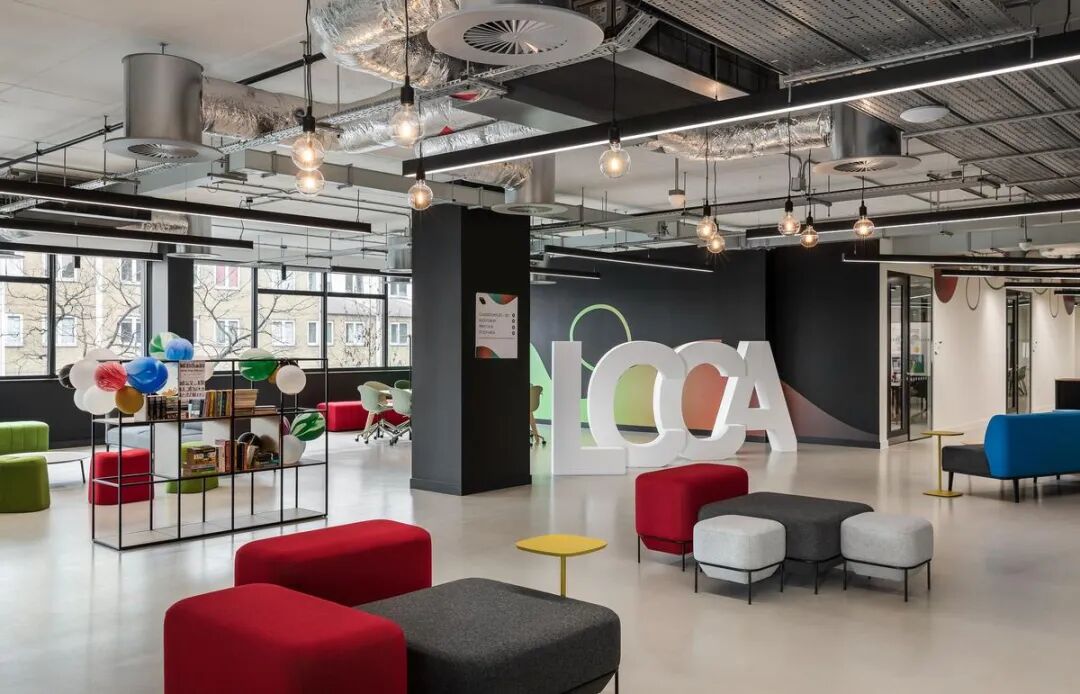
Flexibility is another highlight of this case. To meet the needs of serving as a traditional caf é during the day and supporting campus activities at night, the spatial layout adopts a combination strategy of "fixed+mobile": fixed furniture is set up along the wall, customized sofas and stackable tables and chairs that can be easily moved are configured in the central area, and the space can be quickly switched to social activity scenes such as cocktail parties. The supporting commercial kitchen supports 24-hour independent operation, making the space an active communication node on campus around the clock.
In terms of furniture customization, the design team focuses on the unity of functionality and aesthetics. Customized furniture not only meets the needs of flexible use, but also coordinates and unifies with the overall spatial style, enhancing the practicality and brand recognition of the space.
This renovation successfully transformed a previously dark underground space into a vibrant and multifunctional campus public area. It not only enhances the overall quality of the campus environment, but also provides high-quality reference examples for the practical application of commercial environment design in campus scenes.



 Chinese
 English
 French
 Spanish
 Russian
 Arabic